
Нелинейная оптика конденсированных сред




Публикаций
40
Цитирований
139
Индекс Хирша
6
Необходимо авторизоваться.

- Оптическое охлаждение твердых тел
- Спектроскопия
- Спектроскопия методом накачка-зондирование (Pump-probe spectroscopy)
- Недеструктивная характеризация микро- и нанообъектов
Семён Рудый
Старший научный сотрудник
Вадим Рыбин
Аспирант
Денис Глухарев
Аспирант
Анна Романова
Аспирант
Елизавета Соболева
Аспирант
Максим Семынин
Студент
Всего публикаций
103
Всего цитирований
494
Цитирований на публикацию
4.8
Среднее число публикаций в год
4.48
Годы публикаций
2003-2025 (23 года)
h-index
10
i10-index
13
m-index
0.43
o-index
21
g-index
16
w-index
3
Описание метрик
h-index
Учёный имеет индекс h, если h из его N статей цитируются как минимум h раз каждая, в то время как оставшиеся (N - h) статей цитируются не более чем h раз каждая.
i10-index
Число статей автора, получивших не менее 10 ссылок каждая.
m-index
m-индекс ученого численно равен отношению его h-индекса к количеству лет, прошедших с момента первой публикации.
o-index
Среднее геометрическое h-индекса и числа цитирований наиболее цитируемой статьи ученого.
g-index
Для данного множества статей, отсортированного в порядке убывания количества цитирований, которые получили эти статьи, g-индекс это наибольшее число, такое что g самых цитируемых статей получили (суммарно) не менее g2 цитирований.
w-index
Если w статей ученого имеют не менее 10w цитирований каждая и другие статьи меньше, чем 10(w+1) цитирований, то w-индекс исследователя равен w.
Топ-100
Области наук
Журналы
















Цитирующие журналы






Цитируемые журналы





Издатели
|
5
10
15
20
25
30
35
40
|
|
|
Pleiades Publishing
37 публикаций, 35.92%
|
|
|
Elsevier
9 публикаций, 8.74%
|
|
|
Optica Publishing Group
9 публикаций, 8.74%
|
|
|
IOP Publishing
9 публикаций, 8.74%
|
|
|
Taylor & Francis
6 публикаций, 5.83%
|
|
|
MDPI
4 публикации, 3.88%
|
|
|
AIP Publishing
4 публикации, 3.88%
|
|
|
Wiley
2 публикации, 1.94%
|
|
|
SAGE
2 публикации, 1.94%
|
|
|
American Physical Society (APS)
2 публикации, 1.94%
|
|
|
Cornell University Press
2 публикации, 1.94%
|
|
|
SPIE-Intl Soc Optical Eng
2 публикации, 1.94%
|
|
|
JVE International Ltd.
2 публикации, 1.94%
|
|
|
Springer Nature
1 публикация, 0.97%
|
|
|
World Scientific
1 публикация, 0.97%
|
|
|
Beilstein-Institut
1 публикация, 0.97%
|
|
|
ITMO University
1 публикация, 0.97%
|
|
|
Ioffe Institute Russian Academy of Sciences
1 публикация, 0.97%
|
|
|
L and H Scientific Publishing, LLC
1 публикация, 0.97%
|
|
|
5
10
15
20
25
30
35
40
|
Организации из публикаций
|
10
20
30
40
50
60
70
80
|
|
|
Университет ИТМО
76 публикаций, 73.79%
|
|
|
Организация не определена
|
Организация не определена, 21, 20.39%
Организация не определена
21 публикация, 20.39%
|
|
Государственный оптический институт имени С. И. Вавилова
7 публикаций, 6.8%
|
|
|
Университет Мансура
3 публикации, 2.91%
|
|
|
Институт проблем машиноведения РАН
2 публикации, 1.94%
|
|
|
Санкт-Петербургский Политехнический Университет Петра Великого
2 публикации, 1.94%
|
|
|
Познаньский университет экономики и бизнеса
2 публикации, 1.94%
|
|
|
Физический институт им. П.Н. Лебедева РАН
1 публикация, 0.97%
|
|
|
Физико-технический институт им. А.Ф. Иоффе РАН
1 публикация, 0.97%
|
|
|
Балтийский Федеральный Университет имени Иммануила Канта
1 публикация, 0.97%
|
|

Санкт-Петербургский Государственный Электротехнический Университет «ЛЭТИ» им. В. И. Ленина
1 публикация, 0.97%
|
|
|
Санкт-Петербургский государственный университет
1 публикация, 0.97%
|
|
|
Национальный исследовательский центр "Курчатовский институт"
1 публикация, 0.97%
|
|
|
Петербургский институт ядерной физики имени Б. П. Константинова
1 публикация, 0.97%
|
|
|
Ереванский государственный университет
1 публикация, 0.97%
|
|
|
Технический университет Клуж-Напока
1 публикация, 0.97%
|
|
|
10
20
30
40
50
60
70
80
|











Страны из публикаций
|
10
20
30
40
50
60
70
80
90
|
|
|
Россия
|
Россия, 86, 83.5%
Россия
86 публикаций, 83.5%
|
|
Страна не определена
|
Страна не определена, 19, 18.45%
Страна не определена
19 публикаций, 18.45%
|
|
Египет
|
Египет, 3, 2.91%
Египет
3 публикации, 2.91%
|
|
Польша
|
Польша, 2, 1.94%
Польша
2 публикации, 1.94%
|
|
Армения
|
Армения, 1, 0.97%
Армения
1 публикация, 0.97%
|
|
Румыния
|
Румыния, 1, 0.97%
Румыния
1 публикация, 0.97%
|
|
10
20
30
40
50
60
70
80
90
|
Цитирующие организации























































































Цитирующие страны
- Мы не учитываем публикации, у которых нет DOI.
- Статистика пересчитывается раз в сутки.
Направления исследований
Разработка нелинейных левитодинамических систем для детекции слабых сил
+
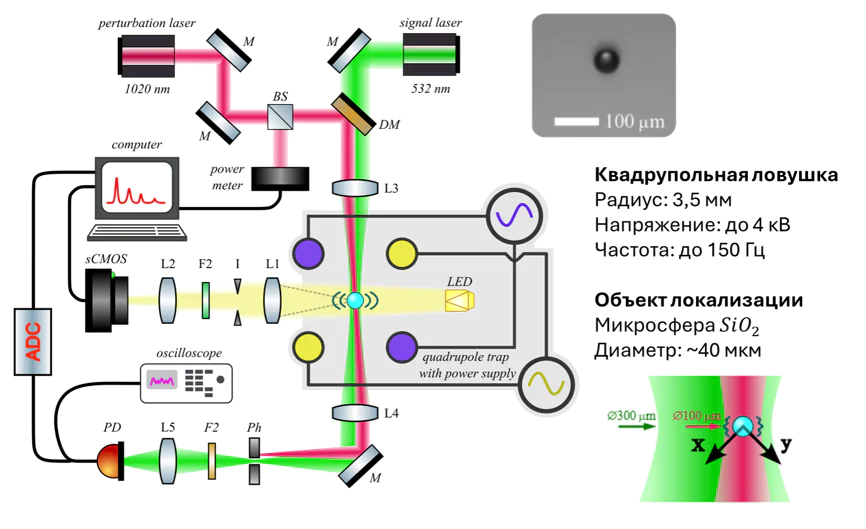
В лаборатории проводятся экспериментальные и теоретические исследования нелинейной динамики микрочастиц, локализованных в радиочастотных ловушках.
В таких системах возможны фазовые переходы между динамическими режимами, при этом точка перехода оказывается чувствительной к внешним воздействиям.
Отслеживание динамики частицы открывает новые возможности для детектирования малых сил.
Исследование процессов хаотизации динамических систем
+

На первый взгляд, хаос это то, у чего нет никаких правил. Но это не так.
Динамические системы переходят из упорядоченной периодической к непредсказуемой хаотической динамике по определенным правилам. И что интересно - эти правила могут проявляться в совершенно разных по своей природе системах - биологических, социологических, физических. Таким образом, исследование процессов хаотизации динамики микрочастиц позволяет исследовать буквально весь мир вокруг нас. Почему микрочастицы в ловушках? Ловушки характеризуются разными параметрами, которыми легко управлять и смотреть, по какому пути динамика пойдет к хаосу.
Исследование нестационарных топологических дефектов в нематических жидких кристаллах
+

Жидкие кристаллы сочетают свойства жидкостей и кристаллов, обладают
внутренней упорядоченностью и высокой чувствительностью к внешним воздействиям.
Они применяются в оптоэлектронике, сенсорах и дисплеях.
В нематиках под действием электрического поля возникают электрогидродинамические неустойчивости — динамические структуры, вызывающие рассеяние проходящего света и флуктуации его интенсивности.
С ростом напряжения размер структур уменьшается, а скорость возрастает.
Такие жидкокристаллические ячейки могут использоваться для модуляции и генерации контролируемого шума, поэтому они применимы в создании источников истинно случайных чисел и реализации вычислительных систем (например, машины Изинга).
Исследование механизмов трансляционного и внутреннего оптического охлаждения твердотельных материалов различных размеров и состава
+

В лаборатории исследуется проблема оптического охлаждения твердотельных систем, к которым относятся объемные кристаллы и нанокристаллы, легированные редкоземельными ионами, а также полупроводниковые гетероструктуры различной размерности. Интерес к получению оптически охлаждаемых объемных кристаллов связан с возможностью получения компактного твердотельного охладителя, не имеющего вибраций, для использования в различных системах нанофотоники и оптоэлектроники. Оптическое охлаждение наночастиц также востребовано для реализации квантового состояния твердотельного нанообъекта в левитирующей оптомеханике.
Исследование модификации энергетического спектра носителей заряда в полупроводниковых наноструктурах под действием сильных оптического и электрического полей
+

Возможность управления свойствами полупроводниковых структур с помощью оптического и электрического полей становится особенно значимой для наноразмерных систем, используемых для создания различных устройств фотоники и оптоэлектроники. Воздействие сильных полей на наноструктуры приводит к фотоиндуцированной перестройке как энергетического спектра носителей заряда, так и колебательного спектра таких структур. В лаборатории проводятся теоретические и экспериментальные исследования механизмов контролируемой светом передачи энергии в электрон-фотон-фононных низкоразмерных системах в условиях оптического и электрического штарк-эффектов.
Разработка нового класса высоко прецизионных акселерометров и гравиметров на базе оптомеханических систем с частицами-сенсорами, левитирующими в радиочастотных ловушках
+

В лаборатории ведётся разработка нового класса акселерометров и гравиметров на базе левитирующих оптомеханических систем. Левитирующие наночастицы, используемые в качестве сенсора в акселерометрических измерениях, показывают чувствительность в измерении динамических ускорений порядка 1е-7 g Гц^(-0.5) (где g - ускорение свободного падения), теоретический предел возможной чувствительности соответствует 3е-12 g Гц^(-0.5). Это открывает путь к созданию компактных, высокоточных сенсоров для фундаментальных исследований.
Пленение и исследование свойств биологических микрообъектов с помощью оптического пинцета
+
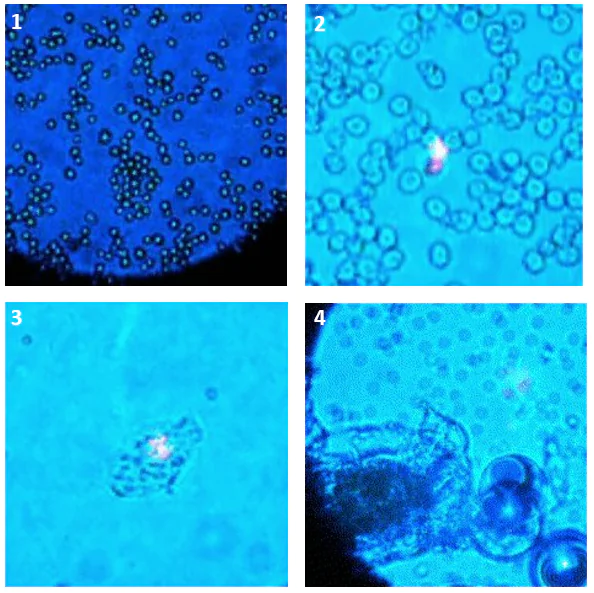
В рамках текущего исследования мы изучаем механические свойства клеточных мембран — направление, которое может лечь в основу новых методов диагностики нейродегенеративных заболеваний. Для отработки методик и понимания поведения мембран в разных условиях в экспериментах использовались разнообразные биологические объекты: от дрожжей (1) и эритроцитов (2) до клеток линии HeLa, предположительно — карциномы (3), и даже тихоходки (4). Такое разнообразие позволяет оценить универсальность подхода и выявить особенности механического отклика мембран, которые в перспективе могут служить чувствительными биомаркерами при патологических изменениях.
Публикации и патенты
Найдено
Ничего не найдено, попробуйте изменить настройки фильтра.

Семён Сергеевич Рудый, Владислав Евгеньевич Ларионов, Антон Юрьевич Рождественский, Дмитрий Павлович Щербинин, Андрей Витальевич Иванов
RU2839953,
2025
2024
—
| Рудый Семён Сергеевич
2024
—
| Щербинин Дмитрий Павлович
2022
—
2024
| Рождественский Юрий Владимирович
Партнёры




Адрес лаборатории
Санкт-Петербург, Биржевая линия, дом 14
Необходимо авторизоваться.