
Центр вычислительной физики ЛФИ МФТИ





Публикаций
50
Цитирований
671
Индекс Хирша
14
Необходимо авторизоваться.
Мы занимаемся моделированием физико-химических процессов на самых разных масштабах: молекулярное моделирование, статистические модели, модели в масштабе пор, сплошной среды, и разнообразные промежуточные решения на мезомасштабе, газо/гидродинамика. В своих исследованиях мы активно применяем высокопроизводительные вычисления и машинное обучение. Активно сотрудничаем с заинтересованными ведущими научными организациями и индустриальными партнерами по всему миру.
- Высокопроизводительные вычисления
- Молекулярная динамика и квантово-химические расчеты
- Численное моделирование

Рабочие станции для проведения расчетов
Лабораторный корпус, 213 ЛК

Лабораторный корпус, 212 ЛК

Владимир Дещеня
Младший научный сотрудник
Вячеслав Лукьянчук
Младший научный сотрудник
Иван Бакулин
Младший научный сотрудник
Мария Ваганова
Младший научный сотрудник
Борис Никитюк
Младший научный сотрудник
Алексей Черкасов
Младший научный сотрудник
Денис Потапов
Аспирант
Георгий Вандышев
Лаборант-исследователь
Олег Кашурин
Студент
Всего публикаций
6
Всего цитирований
243
Цитирований на публикацию
40.5
Среднее число публикаций в год
0.75
Годы публикаций
2018-2025 (8 лет)
h-index
6
i10-index
4
m-index
0.75
o-index
24
g-index
6
w-index
3
Описание метрик
h-index
Учёный имеет индекс h, если h из его N статей цитируются как минимум h раз каждая, в то время как оставшиеся (N - h) статей цитируются не более чем h раз каждая.
i10-index
Число статей автора, получивших не менее 10 ссылок каждая.
m-index
m-индекс ученого численно равен отношению его h-индекса к количеству лет, прошедших с момента первой публикации.
o-index
Среднее геометрическое h-индекса и числа цитирований наиболее цитируемой статьи ученого.
g-index
Для данного множества статей, отсортированного в порядке убывания количества цитирований, которые получили эти статьи, g-индекс это наибольшее число, такое что g самых цитируемых статей получили (суммарно) не менее g2 цитирований.
w-index
Если w статей ученого имеют не менее 10w цитирований каждая и другие статьи меньше, чем 10(w+1) цитирований, то w-индекс исследователя равен w.
Топ-100
Области наук
|
1
2
|
|
|
General Physics and Astronomy
|
General Physics and Astronomy, 2, 33.33%
General Physics and Astronomy
2 публикации, 33.33%
|
|
Water Science and Technology
|
Water Science and Technology, 1, 16.67%
Water Science and Technology
1 публикация, 16.67%
|
|
1
2
|
Журналы
|
1
2
|
|
|
Advances in Water Resources
2 публикации, 33.33%
|
|
|
Physical Review Letters
1 публикация, 16.67%
|
|
|
Physics-Uspekhi
1 публикация, 16.67%
|
|
|
Physical Review E
1 публикация, 16.67%
|
|
|
Colloids and Surfaces A: Physicochemical and Engineering Aspects
1 публикация, 16.67%
|
|
|
1
2
|


Цитирующие журналы
















Цитируемые журналы














Издатели
|
1
2
3
|
|
|
Elsevier
3 публикации, 50%
|
|
|
American Physical Society (APS)
2 публикации, 33.33%
|
|
|
Uspekhi Fizicheskikh Nauk Journal
1 публикация, 16.67%
|
|
|
1
2
3
|
Организации из публикаций
|
1
2
3
4
|
|
|
Московский физико-технический институт
4 публикации, 66.67%
|
|
|
Институт физики Земли имени О. Ю. Шмидта РАН
3 публикации, 50%
|
|
|
Национальный исследовательский университет «Высшая школа экономики»
2 публикации, 33.33%
|
|
|
Объединенный институт высоких температур РАН
2 публикации, 33.33%
|
|
|
Казанский Федеральный Университет
2 публикации, 33.33%
|
|
|
ФИЦ Почвенный институт им. В.В. Докучаева
2 публикации, 33.33%
|
|
|
Институт динамики геосфер имени академика М.А. Садовского РАН
2 публикации, 33.33%
|
|
|
Организация не определена
|
Организация не определена, 1, 16.67%
Организация не определена
1 публикация, 16.67%
|
|
Институт искусственного интеллекта AIRI
1 публикация, 16.67%
|
|
|
Федеральный исследовательский центр "Информатика и управление" РАН
1 публикация, 16.67%
|
|
|
Хайфский университет
1 публикация, 16.67%
|
|
|
1
2
3
4
|








Страны из публикаций
|
1
2
3
4
5
|
|
|
Россия
|
Россия, 5, 83.33%
Россия
5 публикаций, 83.33%
|
|
Страна не определена
|
Страна не определена, 1, 16.67%
Страна не определена
1 публикация, 16.67%
|
|
Израиль
|
Израиль, 1, 16.67%
Израиль
1 публикация, 16.67%
|
|
1
2
3
4
5
|
Цитирующие организации






















































































Цитирующие страны
|
10
20
30
40
50
60
70
80
|
|
|
Россия
|
Россия, 73, 30.04%
Россия
73 цитирования, 30.04%
|
|
Китай
|
Китай, 37, 15.23%
Китай
37 цитирований, 15.23%
|
|
Страна не определена
|
Страна не определена, 26, 10.7%
Страна не определена
26 цитирований, 10.7%
|
|
США
|
США, 22, 9.05%
США
22 цитирования, 9.05%
|
|
Германия
|
Германия, 16, 6.58%
Германия
16 цитирований, 6.58%
|
|
Великобритания
|
Великобритания, 9, 3.7%
Великобритания
9 цитирований, 3.7%
|
|
Австралия
|
Австралия, 6, 2.47%
Австралия
6 цитирований, 2.47%
|
|
Саудовская Аравия
|
Саудовская Аравия, 6, 2.47%
Саудовская Аравия
6 цитирований, 2.47%
|
|
Франция
|
Франция, 5, 2.06%
Франция
5 цитирований, 2.06%
|
|
Нидерланды
|
Нидерланды, 5, 2.06%
Нидерланды
5 цитирований, 2.06%
|
|
Австрия
|
Австрия, 4, 1.65%
Австрия
4 цитирования, 1.65%
|
|
Бельгия
|
Бельгия, 3, 1.23%
Бельгия
3 цитирования, 1.23%
|
|
Индия
|
Индия, 3, 1.23%
Индия
3 цитирования, 1.23%
|
|
Иран
|
Иран, 3, 1.23%
Иран
3 цитирования, 1.23%
|
|
Швейцария
|
Швейцария, 3, 1.23%
Швейцария
3 цитирования, 1.23%
|
|
Япония
|
Япония, 3, 1.23%
Япония
3 цитирования, 1.23%
|
|
Бразилия
|
Бразилия, 2, 0.82%
Бразилия
2 цитирования, 0.82%
|
|
Дания
|
Дания, 2, 0.82%
Дания
2 цитирования, 0.82%
|
|
Израиль
|
Израиль, 2, 0.82%
Израиль
2 цитирования, 0.82%
|
|
Греция
|
Греция, 1, 0.41%
Греция
1 цитирование, 0.41%
|
|
Индонезия
|
Индонезия, 1, 0.41%
Индонезия
1 цитирование, 0.41%
|
|
Канада
|
Канада, 1, 0.41%
Канада
1 цитирование, 0.41%
|
|
Малайзия
|
Малайзия, 1, 0.41%
Малайзия
1 цитирование, 0.41%
|
|
ОАЭ
|
ОАЭ, 1, 0.41%
ОАЭ
1 цитирование, 0.41%
|
|
Пакистан
|
Пакистан, 1, 0.41%
Пакистан
1 цитирование, 0.41%
|
|
Польша
|
Польша, 1, 0.41%
Польша
1 цитирование, 0.41%
|
|
Сенегал
|
Сенегал, 1, 0.41%
Сенегал
1 цитирование, 0.41%
|
|
Швеция
|
Швеция, 1, 0.41%
Швеция
1 цитирование, 0.41%
|
|
10
20
30
40
50
60
70
80
|
- Мы не учитываем публикации, у которых нет DOI.
- Статистика пересчитывается раз в сутки.
Направления исследований
Моделирование жидкостей на уровне атомов и молекул
+

Мы занимаемся атомистическим моделированием промышленных жидкостей: растворителей, топлив, масел и смазочных материалов. Нас интересует предсказательная сила атомистического моделирования. Подобные расчеты необходимы для проведения мультимасштабного моделирования физических процессов: течения жидкости в механизмах (смазочный материал), в межпоровом пространстве (добыча топлива), сквозь мембраны (добыча лития). Мы принимаем участие в Конкурсах по расчету свойств промышленных жидкостей, проводящийся лидерами индустрии США (Army Research Lab, Dow Chemical, NIST и проч.). В 2018 году наша команда заняла второе место на конкурсе, обойдя в том числе коллективы из NIST, Imperial College London, Shanghai Jiao Tong Univ. В 2019 году — первое место среди участников из Army Research Lab, John Hopkins Univ., Caltech и Shanghai Jiao Tong Univ. Конкурсанты боролись в точности предсказания свойств смазочной жидкости при экстремальных давлениях. В 2023 мы тоже победили по точности предсказания вязкости бинарных смесей.
Повышение эффективности работы расчетных систем на гибридных вычислительных архитектурах
+

Применение современных методов и GPU-технологий позволяет ускорить процессы расчета сторонних реализаций в десятки раз и сократить затраты на электроэнергию в разы, в сравнении с подходами, использующими только CPU. Наш коллектив обладает лидирующими компетенциями в области оптимизации и профилирования расчетных кодов под конкретные гибридные архитектуры. Мы располагаем доступом на ведущие суперкомпьютеры России.
Опыт применения, оценки и ускорения различных методов и программных реализаций: StarCCM, Ansys CFX, Fluent, FlowVision, OpenFOAM, Trilinos PETSc, AMGX, Hypre, amgcl, GROMACS, LAMMPS, OpenMM…
Созданная командой высокоэффективная header-only OpenSource библиотека для реализации вычислительных высокопроизводительных методов
50+ статей по направлению в Scopus/WOS
Оптимальное управление, комплексная оптимизация процессов, решение обратных задач
+
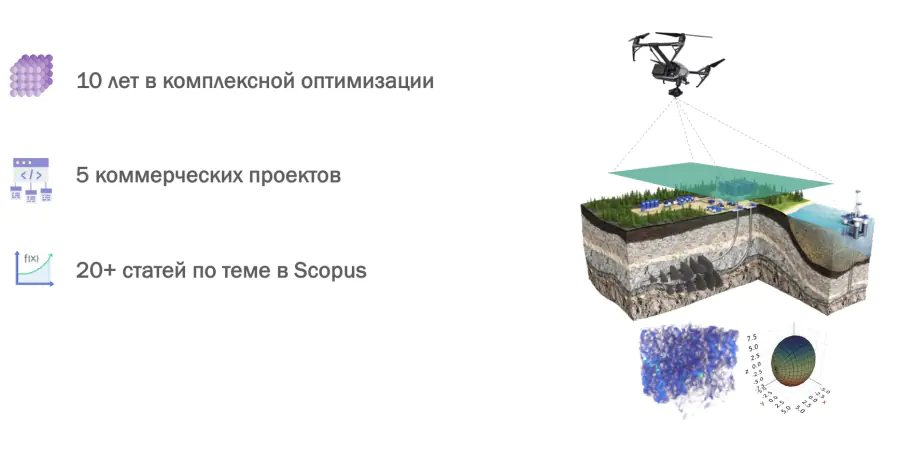
Разработка математических моделей оптимизируемого процесса, учет необходимых ограничений и параметров, с помощью изменения которых нужно провести оптимизацию, построение целевой функции, нахождение значений параметров, при которых целевая функция принимает максимальное (минимальное) значение. По этой тематике у нашего коллектива:
10 лет в комплексной оптимизации
5 коммерческих проектов
20+ статей по теме в Scopus
Разработка симуляторов физико-химических процессов и явлений
+
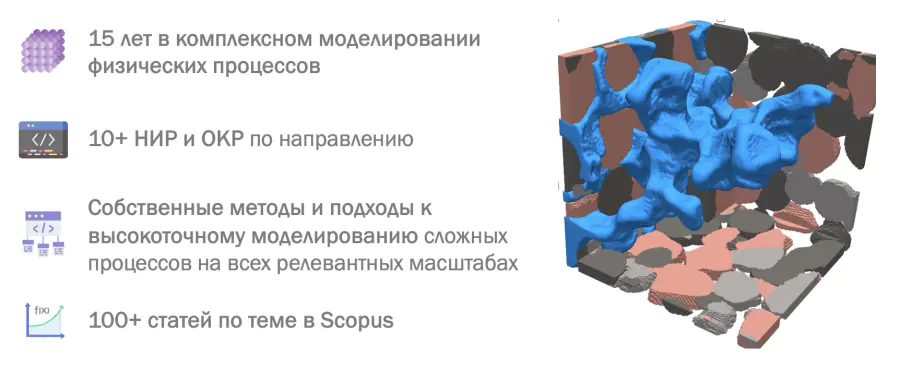
Мы разрабатываем мультифизичные симуляторы – программное обеспечение, моделирующее физико-химические процессы разной природы: течения в пористых средах, фильтрацию примесей, теплофизику, моделирование упругих свойств и разрушения материалов, моделирование сыпучих сред. Наши решения позволяют воспроизвести детали технического процесса при условиях и параметрах, недоступных в эксперименте на всех интересующих масштабах.
Моделирование в масштабе пор
+

Мы занимаемся разработкой и применением прямых методов и поросетевых моделей для описания многофазной фильтрации в пористых средах. На практике такие модели внедряются нашим коллективом в нефтегазовой индустрии, гидрологии и почвоведении, в материаловедении.
Публикации и патенты
Найдено
Ничего не найдено, попробуйте изменить настройки фильтра.

2024
—
2027
| Герке Кирилл Миронович
2024
—
2026
| Копаничук Илья Владимирович
Партнёры
Геологический факультет МГУ









Адрес лаборатории
Долгопрудный, Институтский переулок, д. 9
Необходимо авторизоваться.